Showing posts with label Guyana. Show all posts

Wednesday, February 11, 2015

Celebrating 33 Years of Service

Food For The Poor Celebrates 33 Years of Lovingly Serving the Poor

Food For The Poor celebrates 33 years of service.
In 2014, Food For The Poor contracted to build 33 schools. This little girl in Honduras is using one of the many computers donated to the organization. Since its inception, Food For The Poor has shipped more than 70,000 tractor-trailer loads of essential goods.

Related Items:

COCONUT CREEK, Fla. (Feb. 11, 2015) – Thanks to loyal support from a diverse group of donors, Food For The Poor will celebrate 33 years of devoted service to the poor on Thursday, Feb. 12.

Committed to helping one person at a time, one family at a time, Food For The Poor’s core life-transforming strategies are food, housing, water and education. With its offices in Jamaica, Haiti, and Guyana, the organization is helping people in 17 countries throughout the Caribbean and Latin America to break the cycle of poverty.

“It’s very hard for many poor families to think about the future, when their primary focus is finding food, water and a safe place to sleep for the night. For more than three decades, this ministry has met many of those basic needs, but the goal of this organization is to provide families with an opportunity to become self-sustaining,” said Robin Mahfood, President/CEO of Food For The Poor. “With the help of our donors, Food For The Poor has implemented animal husbandry, agricultural and aquaculture projects, and provides technical training that is helping families to generate income and to care for their own.”

Food For The Poor started out as a feeding program in Jamaica in 1982 and is now ranked by The Chronicle of Philanthropy as the largest international charity in the United States. Through its dedicated donors, the charity has built more than 98,000 housing units, shipped more than 70,000 tractor-trailer loads filled with essential goods, completed more than 1,943 water projects, and has delivered nearly $11 billion in aid since its inception. 

Food For The Poor is also committed to helping the victims of the Haiti earthquake, which devastated the Caribbean country in January 2010. Since the tragedy in Haiti, the ministry has built 5,015 permanent two-room concrete block homes with water and sanitation components, drilled 372 water wells, which provide more than 1.1 million people with clean water each day and built or restored 35 schools in the Port-au-Prince area.

Food For The Poor is also building villages, community centers, and clinics for people in need. Click www.FoodForThePoor.org/tour to see how Food For The Poor is fulfilling its mission to save and to transform lives, while renewing hope.

Food For The Poor, named by The Chronicle of Philanthropy as the largest international relief and development organization in the nation, does much more than feed millions of the hungry poor in 17 countries of the Caribbean and Latin America. This interdenominational Christian ministry provides emergency relief assistance, clean water, medicines, educational materials, homes, support for orphans and the aged, skills training and micro-enterprise development assistance, with more than 95 percent of all donations going directly to programs that help the poor. For more information, please visit www.FoodForThePoor.org.

Monday, December 22, 2014

Christmas Special

Food For The Poor Releases Nonviolent Prisoners in Jamaica, Guyana, Haiti and Honduras

Food For The Poor has released 68 prisoners who have committed nonviolent offenses in four countries.
Seventeen prisoners were released from St. Catherine Adult Correctional Centre in Spanish Town, Jamaica, on Dec. 10.

Related Item:

COCONUT CREEK, Fla. (Dec. 22, 2014) – Food For The Poor has released 68 prisoners who have committed nonviolent offenses in Jamaica, Guyana, Haiti and Honduras in time to spend Christmas with their families. The nonviolent prisoners were incarcerated due to their inability to pay required fines.

“There are large numbers of desperate people who are locked in jail that have been forgotten because they stole whatever they could to try to feed their hungry families,” said Robin Mahfood, Food For The Poor’s President/CEO. “It is a serious situation. The Gospel message strengthens and reminds us to give a hand up to others who dwell in darkness.”

Seventeen prisoners were released from St. Catherine Adult Correctional Centre in Spanish Town, Jamaica, on Dec. 10. One of the inmates was a 45-year-old barber from Kingston, Jamaica. On Dec. 9, bailiffs took him from his shop because he had breached the Debtors Act, an offense that warrants 14 days in prison. As a barber, and the father of three, he found it difficult to continue to pay the back-log in rent when his business slowed. One of his last payments was made in November.

“It happened so quickly, I was not even allowed to call or talk to anyone,” said the inmate. “When I came here, I begged an officer for a call and contacted my wife and explained the situation. I begged her not to tell my children, especially my daughter in high school, because it would devastate her.

“I prayed the whole night because I am the breadwinner for the family and I didn’t know what was going to happen to them. I said ‘God, is this a trial that You are putting me through to make me develop, or is this a way to teach me a lesson? I know You are real, and You have never failed me yet’.”

Call it a Christmas miracle, but by morning the inmate’s prayer had been answered. Food For The Poor’s Prison Ministry team had intervened and paid the nonviolent prisoners’ outstanding fines, granting them an early release. 

“People ask how I am so lucky, but I know God is powerful. I know He answered my prayer by sending angels this morning,” said the inmate. “I know that God was going to take care of me. Water came to my eyes this morning in the chapel when the gentlemen from Food For The Poor said that we must give the gift of forgiveness to our enemies and that is what I plan to do.” 

On Dec. 16, nine nonviolent prisoners were offered second chances when they were released from three prisons in Guyana. One of the prisoners celebrated his 42nd birthday the same day he was unexpectedly released from prison.

“I am very thankful and grateful to Food For The Poor,” said the inmate, who plans to return to work as a welder. “It is a blessing to me since today is my birthday. I wish you all the best. God bless you all. It was a pleasant surprise to me.”

In developing countries, the destitute sometimes have no way to feed their families other than to steal food. The consequence often is imprisonment, without first appearing before a judge, or receiving a prison sentence.

Prison conditions are drastically worse in developing countries than they are in the United States. Overcrowded prisons are common, and perpetuate the spread of disease and violence. The potential spread of cholera in Haiti’s prisons remains a concern.

Twice a year – during the Christmas and Easter seasons – it is a Food For The Poor tradition to release nonviolent inmates who have been incarcerated due to their inability to pay the required fines for committing minor offenses.

Since the inception of Food For The Poor’s Prison Ministry Program in 1998, the charity has assisted in freeing, training and reintroducing prisoners back into the community as productive citizens.

Food For The Poor’s Prison Ministry Program is based on the scripture, “…I was in prison and you visited me,” (Matthew 25: 36b).

To support Food For The Poor’s Prison Ministry Program, checks payable to Food For The Poor can be mailed to 6401 Lyons Road, Coconut Creek, Fla. 33073. Please include reference number “SC# 74122” to ensure your donation is correctly routed.

Food For The Poor, named by The Chronicle of Philanthropy as the largest international relief and development organization in the nation, does much more than feed millions of the hungry poor in 17 countries of the Caribbean and Latin America. This interdenominational Christian ministry provides emergency relief assistance, clean water, medicines, educational materials, homes, support for orphans and the aged, skills training and micro-enterprise development assistance, with more than 95 percent of all donations going directly to programs that help the poor. For more information, please visit www.FoodForThePoor.org.

Wednesday, June 18, 2014

Celebrating service

Three Countries, Three Anniversaries All in One Month

A girl at an orphanage in Guyana holds one of the chickens used in a self-sustaining development program.

Related Item:

COCONUT CREEK, Fla. (June 18, 2014) – Food For The Poor is celebrating decades of dedicated service in the countries of Jamaica, Haiti and Guyana in the month of June. The organization, which was founded in 1982, now includes more than 5,000 churches and institutions as partners in the distribution of food, medicine, educational supplies and other needed items.

Thirty-two years ago today, Jamaica became the first country to receive assistance from the relief and development organization. The Food For The Poor-Jamaica office and warehouse complex are located in Spanish Town at the intersection of five highways, which lead to all parts of the island. Food For The Poor has completed more than 250 projects in Jamaica over the past five years, and continues to replace dilapidated shacks with permanent housing. In 2013, Food For The Poor, through the generosity of donors, constructed 2,456 housing units throughout the country. Since inception, the charity has built 37,340 housing units island-wide.

“Thousands of people remain on a waiting list to receive Food For The Poor housing across Jamaica. This organization will continue to help as many people as possible by focusing on one family at a time. This is the only way to approach the situation, if not, then it would become overwhelming,” said Robin Mahfood, President and CEO of Food For The Poor. “Housing, education and self-sustaining projects are major areas of focus, with the goal of meeting the immediate needs of the truly destitute, and ultimately helping the poor to rise out of poverty.”

It was the plea for help from the poorest of the poor living in inhumane conditions in Cite Soleil, located in the capital of Port-au-Prince, which turned Food For The Poor’s heart toward Haiti in 1986. This long-established presence allowed the organization to respond immediately when the Jan. 12, 2010 earthquake devastated the country. The same rapid response the charity mobilized during the earthquake crisis was activated when news of the October 2010 cholera outbreak reached Food For The Poor. Now the organization has once again stepped in to help on the heels of another potential outbreak – the Chikungunya virus.

“This virus or ‘the fever’ that’s being transmitted by mosquitoes is spreading fast, and now that the rainy season is here, it is on the verge of becoming an epidemic,” said Mahfood. “The Food For The Poor-Haiti office made an urgent request for medicine in May, and more than 8,000 boxes and bottles making up seven pallets have been shipped. Food For The Poor will continue to monitor the situation and will work on securing more medicines as needed.”

There also are dozens of ongoing Food For The Poor supported projects in Haiti. These projects include: aquaculture, animal husbandry, agricultural, orphan-support,  housing and sanitation, community development, water improvement, school construction and support, feeding programs, fishing villages, alternative energy, and medical initiatives.

Since the 2010 earthquake a total of 4,605 two-room homes have been constructed in Haiti. Clean water also is a critical need in the Caribbean country. Food For The Poor installed 121 water wells in 2013, and with the help of Water Missions International, has installed a total of 78 water filtration units, plus three chlorinators since 2010. Each unit purifies and chlorinates up to 10,000 gallons of water a day. 

Twenty-three years ago this month, Food For The Poor began working in Guyana, delivering food and other basic items to Guyana’s poor. Since then, the South Florida-based nonprofit has expanded its services to meet the growing needs of the country’s impoverished residents. It is now the leading organization providing relief to the people of Guyana.

In 2012, the organization constructed the Hosanna Village in the community of Mashabo, Essequibo Coast, and started the construction of 40 homes and a water project for the Swan Village located close to the Soesdyke Highway.  Last year, work continued on the development of the Swan Village, with 25 additional homes and a community center.

This year, an ambitious project has stretched to build a village in an extremely remote area in the northwestern part of the country. When completed, the village will have 40 homes, a community center and a renovated and expanded primary school. Food For The Poor has delivered more than 900 computer workstations to the South American country, and built 3,134 housing units in Guyana to date.

“When you add it all up, there’s a total of more than 82 years of combined dedicated service between these three countries. Words cannot express the gratitude we have toward the Food For The Poor staff, the donors and most importantly for our heavenly Father, who has opened up the floodgates of heaven onto this organization so that we can help others,” said Mahfood.

Food For The Poor, named by The Chronicle of Philanthropy as the largest international relief and development organization in the nation, does much more than feed millions of the hungry poor in 17 countries of the Caribbean and Latin America. This interdenominational Christian ministry provides emergency relief assistance, clean water, medicines, educational materials, homes, support for orphans and the aged, skills training and micro-enterprise development assistance, with more than 95 percent of all donations going directly to programs that help the poor. For more information, please visit www.FoodForThePoor.org.

Wednesday, December 18, 2013

Inmates go home for Christmas

Untitled Document
Food For The Poor also will release prisoners in Guyana (15), Haiti (10) and Honduras (22) in time for them to spend Christmas with their families.
(L to R) Sandra Ramsey and a prison guard at Tower Street Adult Correctional Centre in Jamaica release an inmate in time to spend Christmas with his family.

Related Item:

COCONUT CREEK, Fla. (Dec. 18, 2013) – Thirty-three prisoners received a second chance from Food For The Poor at St. Catherine Adult Correctional Centre in Spanish Town, Jamaica, on Dec. 13. Only after the inmates were escorted from their cells to the center’s Chapel did they believe that generous Food For The Poor donors had paid the fines for their nonviolent offenses, and that they would be released in time to spend Christmas with their families.     

In addition to releasing a total of 37 inmates from three prisons in Jamaica, Food For The Poor also will release prisoners in Guyana (15), Haiti (10) and Honduras (22) in time for them to spend Christmas with their families.

At the St. Catherine Adult Correctional Centre’s newly refurbished chapel, the inmates were greeted by The Very Reverend Burchell McPherson, Bishop of Montego Bay, Jamaica; Father Richard Martin, pastor at Church of the Nativity, in Burke, Va.; Jevene Bent, Jamaica’s Commissioner of Corrections; and Robin Mahfood, President/CEO of Food For The Poor.

“We pray the released inmates will recognize that God is merciful, and He is a God of second chances,” said Mahfood.

During the dedication of the chapel, the inmates received words of advice from the distinguished guests. Bent encouraged the inmates to use their experience in prison to influence someone to become a better person, and cautioned them never to return and lose their freedom again.

“I was thankful Food For The Poor intervened to release the men and women who could not afford to pay their meager fines,” said Bishop McPherson.

“I see the real stars in front of me right now,” said Fr. Martin, to the inmates at St. Catherine Adult Correctional Centre. “Stars give light and you have given me that light. I feel like I am living out the scriptures today as outlined in Mathew 25. You have a great future ahead and you can shine even brighter than you are already doing.”

Food For The Poor’s Prison Ministry Program is based on the scripture, “When was it that we saw you sick or in prison and visited you…” (Matthew 25: 31-46).

“I have been commissioner for just under six months now and everywhere I go, every penal institution I visit, all I hear is Food For The Poor,” said Bent.  “We have had many partners over the years but Food For The Poor stands out not only in terms of material provision to the prisons and inmates but also the spiritual component that you bring. Food For The Poor, may God continue to bless you and expand your boundaries.”

In developing countries, the destitute sometimes have no way to feed their families other than to steal food. The consequence often is imprisonment without first appearing before a judge, or receiving a prison sentence. Sometimes, by the time they are tried, they have spent years longer in jail than their prison sentence requires.

“Prison conditions and poverty are drastically worse in developing countries than they are in the United States,” said Mahfood. “Overcrowded prisons are common, and perpetuate the spread of disease and violence.”

Twice a year – during the Christmas and Easter seasons – it is a Food For The Poor tradition to release nonviolent inmates who have been incarcerated due to their inability to pay the required fines for committing minor offenses.

Since the inception of Food For The Poor’s Prison Ministry Program in 1998, the charity has assisted in freeing, training and reintroducing prisoners back into the community as productive citizens.

To support Food For The Poor’s Prison Ministry Program, checks payable to Food For The Poor can be mailed to 6401 Lyons Road, Coconut Creek, Fla. 33073. Please include reference number “SC# 74122” to ensure your donation is correctly routed.

Food For The Poor, named by The Chronicle of Philanthropy as the largest international relief and development organization in the nation, does much more than feed millions of the hungry poor in 17 countries of the Caribbean and Latin America. This interdenominational Christian ministry provides emergency relief assistance, clean water, medicines, educational materials, homes, support for orphans and the aged, skills training and micro-enterprise development assistance, with more than 95 percent of all donations going directly to programs that help the poor. For more information, please visit www.FoodForThePoor.org.


Monday, December 17, 2012

Food For The Poor Organizes Prisoner Releases, Nonviolent Offenders Freed in Jamaica, Guyana and Haiti

Untitled Document
Natalie Carlisle, a Food For The Poor staff member, washed the feet of the nonviolent inmates at St. Catherine Adult Correctional Centre before they were released.
Related Information:
COCONUT CREEK, Fla. (Dec. 17, 2012) – Hearing visitors’ voices in the corridor, anxious prisoners race to stretch their arms through the cell door bars; praying someone from the outside will squeeze their hand.
Fifteen prisoners from St. Catherine Adult Correctional Centre in Spanish Town, Jamaica, were escorted from their cells to a room, where they were greeted by Food For The Poor staff and donors from the United States. Just as Jesus washed the disciples’ feet – the visitors kneeled before the prisoners, and gently washed the inmates’ feet. Dressed in new shoes, the cleansed inmates learned Food For The Poor donors had paid the fines for their nonviolent offenses, and that they would be released in time to spend Christmas with their families.    
“We all make mistakes and can testify that we have received many chances from persons who love and care for us,” said Jacqueline Johnson, Food For The Poor-Jamaica’s Executive Director, to the inmates at St. Catherine Adult Correctional Centre.
Johnson encouraged each beneficiary to return to society not being bitter men, but being grateful. “If ever you should return, come back not as an inmate, but rather as an inspiration and a beacon of light to the men you’ll be leaving here today,” she said. 
“When I heard my name, I thought there was another inmate with that name in the room,” said a 23-year-old inmate released from Tamarind Farm Adult Correctional Centre in Jamaica. “I couldn’t believe it, but I thank Food For The Poor and the donors for a second chance.”
This year in Jamaica, a total of 18 inmates were released from prisons in Spanish Town and Kingston.
Twice a year – during the Christmas and Easter seasons – it is a Food For The Poor tradition to release nonviolent inmates who have been incarcerated due to their inability to pay the required fines for committing minor offenses. This year prisoners also will be released in Guyana and Haiti.
In developing countries, the destitute sometimes have no way to feed their families other than to steal food. The consequence often is imprisonment without first appearing before a judge, or receiving a prison sentence. Sometimes, by the time they are tried, they have spent years longer in jail than their prison sentence requires.
“When you visit a prison, desperate eyes peer out of the dark cells, into the light, pleading silently for help,” said Robin Mahfood, Food For The Poor’s CEO/President. “They want to feel a connection with the outside world, to be a brother in Christ, to be prayed for – and not to be forgotten.”
Food For The Poor’s Prison Ministry Program is based on the scripture, “When was it that we saw you sick or in prison and visited you…” (Matthew 25: 31-46).
Food For The Poor, named by The Chronicle of Philanthropy as the largest international relief and development organization in the nation, does much more than feed millions of the hungry poor in 17 countries of the Caribbean and Latin America. This interdenominational Christian ministry provides emergency relief assistance, clean water, medicines, educational materials, homes, support for orphans and the aged, skills training and micro-enterprise development assistance, with more than 96 percent of all donations going directly to programs that help the poor. 
For more information, please visit www.FoodForThePoor.org.

Tuesday, August 21, 2012

Food For The Poor thanks Office Depot Foundation

Thanks to the generosity of the Office Depot Foundation, the international relief and development organization Food For The Poor will be able to provide 4,000 sackpacks for the children in its Angels Of Hope program in Jamaica, Honduras, Nicaragua, El Salvador, Guyana and Guatemala.

“This beautiful donation will allow children to enter the school year with supplies that have the potential to change their lives,” said Angel Aloma, Executive Director of Food For The Poor. “We know that if we ever are going to break the cycle of poverty, it will come through education. Through this gift, these children will be offered the chance at dignity, success and hope for the future.”

Caring donors to Food For The Poor have sponsored approximately 3,800 children in 95 homes, which are dedicated to serving orphaned, abandoned, abused and malnourished children. Many of the sackpacks already have been distributed at various Day of Celebration events at the Angels Of Hope homes. The next distribution is planned for September in Honduras.

“The Office Depot Foundation is proud to partner with Food For The Poor in our 2012 National Backpack Program,” said Mary Wong, President of Office Depot Foundation. “The fact that this partnership helps to extend the impact of the program internationally is exceptionally gratifying.  We are committed to helping children succeed in school wherever they may be.”

Food For The Poor, named by The Chronicle of Philanthropy as the largest international relief and development organization in the nation, does much more than feed millions of the hungry poor in 17 countries of the Caribbean and Latin America. This interdenominational Christian ministry provides emergency relief assistance, clean water, medicines, educational materials, homes, support for orphans and the aged, skills training and micro-enterprise development assistance, with more than 96 percent of all donations going directly to programs that help the poor.  For more information, please visit www.FoodForThePoor.org.

Contact:
Kathy Skipper
Director of Public Relations
954-427-2222 x 6614
kathys@foodforthepoor.org

Friday, June 29, 2012

Donated dorm, hospital and school furnishings: Making lives better via Food For The Poor

COCONUT CREEK, Fla. (June 28, 2012) – The old adage, one person’s trash is another person’s treasure has never been more true for tens of thousands in parts of the Caribbean and Latin America who are the recipients of donated items processed by the Institution Recycling Network and distributed by Food For the Poor.

“All of these furnishings are in usable condition.  If they were broken or worn out, they would have been thrown away,” said Mark Lennon of the Institution Recycling Network (IRN), which is located in Concord, N.H. “It is a huge waste of resources to throw away furniture and equipment that can still be used.”

These usable goods were donated to the international relief and development organization Food For The Poor.  Dorm room beds, dressers and night tables, plus desks from various educational institutions from across the country have been refurbished for use by a new generation of students and families.

“When we see couches that once filled the lobbies of college campuses, now fill the lobbies of orphanages in Guyana; and when families who receive Food For The Poor houses in Jamaica also get to furnish their new homes with twin beds and dorm-room dressers, we are truly humbled by the generosity of our donors,” said Angel Aloma, Executive Director of Food For The Poor. “We are especially grateful when we see donated hospital beds have replaced the worn and rusted-out hospital furnishings that were being used in clinics throughout El Salvador.”

For more than three decades, Food For The Poor has been a dedicated servant of the poor, delivering food and other basic items to the 17 countries it serves.  The organization’s staff works closely with its partners to provide medical supplies, vocational training equipment, and school furniture to various projects such as the Ecole Reap de Morel basic school in Leogane, Haiti.

The school was destroyed during the 2010 earthquake.  The new school was inaugurated on March 24, 2012, thanks to the fundraising efforts of 12-year-old Rachel Wheeler of Lighthouse Point, Fla., and college-aged twins, Ashton and Chesney Hellmuth of Alexandria, Va., through Food For The Poor. The new school has 10 furnished classrooms, a principal’s office, a staff room, canteen and kitchen. Many of the school’s desks and tables were donations from IRN. 

Established in 1999, IRN’s partnership with Food For The Poor began a decade ago.  More than 1,650 container loads of various  items have been donated by IRN and distributed to all the countries the organization serves. The bulk of the donated school furnishings go to El Salvador, Guyana, Haiti, and Jamaica. 
 
 “Some of the schools we consistently work with are the University of Massachusetts-Amherst, Boston University, Columbia University, the University of Vermont, Emerson College, Santa Clara University, the University of Central Missouri, Notre Dame University, Babson College, Middlebury College and the Claremont Consortium in California,” Lennon said. “It seemed natural that Food For The Poor might need the kind of surplus we have access to, to furnish all their projects.”

Please go to www.FoodForThePoor.org/goods to learn more about their Gifts in Kind department and about what items are needed.

Food For The Poor, named by The Chronicle of Philanthropy as the largest international relief and development organization in the nation, does much more than feed millions of the hungry poor in 17 countries of the Caribbean and Latin America. This interdenominational Christian ministry provides emergency relief assistance, clean water, medicines, educational materials, homes, support for orphans and the aged, skills training and micro-enterprise development assistance, with more than 96 percent of all donations going directly to programs that help the poor.  For more information, please visit www.FoodForThePoor.org.

Contact:
Wanda Wright
Food For The Poor
Public Relations
954-427-2222 x 6079
wandaw@foodforthepoor.com

Thursday, April 5, 2012

Canned food collected and donated by local Boy Scouts

What started out as a service project for a group of local Boy Scouts on a quest to earn their Eagle Scout Badges, turned into a passionate mission to help the poor.

Six weeks and more than 90 volunteer hours later, 17-year-old Michael Raghunandan and 10 of his fellow Boy Scouts collected 2,500 cans of beans, spam, mackerel and other food items. The boys gave up several weekends to set up collection boxes at the Publix in Cutler Bay, the Villages of Palmetto Bay, the Palmetto Bay Golf Course, and at their local places of worship.

Raghunandan, whose parents are from Guyana and the Cayman Islands, is a student at Westminster Christian School in Palmetto Bay and spearheaded this canned food collection project. He dreams of attending the University of Miami and wants to major in Health Sciences. He said this project took on a special meaning after his research of various nonprofits led him to Food For The Poor.

“We were so impressed that 96 percent of every donation to the organization is used to benefit people and different projects in both Latin America and the Caribbean. After learning the details, we knew this is where we wanted our canned foods to go,” said Raghunandan. “It makes me feel great to be able to put a smile on the faces of people who do not have the basic necessities of life, such as food, water, or even clothing. We are happy we can help.”

The group of Boy Scouts, who represent the Homestead area, personally delivered their donation to Food For The Poor’s headquarters in Coconut Creek on Friday. The donated canned items, along with dozens of can openers, will be divided and shipped to Guyana and Trinidad.

“We are so very appreciative of this group of young men who worked so hard to make this generous donation to Food For The Poor. Hundreds of children soon will benefit from their kindness, which is a blessing to both the givers and the receivers,” said Angel Aloma, Executive Director of Food For The Poor.

Food For The Poor, named by The Chronicle of Philanthropy as the largest international relief and development organization in the nation, does much more than feed millions of the hungry poor in 17 countries of the Caribbean and Latin America. This interdenominational Christian ministry provides emergency relief assistance, clean water, medicines, educational materials, homes, support for orphans and the aged, skills training and micro-enterprise development assistance, with more than 96 percent of all donations going directly to programs that help the poor. For more information, please visit www.FoodForThePoor.org.
Contact:
Wanda Wright
Food For The Poor
Public Relations
954-427-2222 x 6079
wandaw@foodforthepoor.com

Wednesday, February 29, 2012

Kansas City kids make a difference for kids in Guyana

Boxes packed to the brim with all things necessary for school-aged children soon will be shipped to the South American country of Guyana.

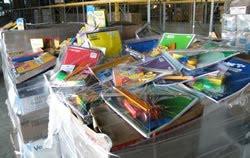
Three pallets of school supplies arrived at Food For The Poor’s headquarters in Coconut Creek, Fla. on Feb. 22, a gift from the middle school students who attend Hyman Brand Hebrew Academy and St. Therese School in Kansas City, Mo. The students set up bins in their classrooms and began collecting the supplies last spring. They lovingly filled oversized plastic bags with spiral notebooks, pencils, crayons and other supplies that will go directly to the school children in Guyana.

“It’s so encouraging to see young people taking the initiative and giving back to society in any way possible,” said Angel Aloma, Executive Director of Food For The Poor. “Because of the effort put forth by these middle school students, many children in Guyana, who don’t even have access to pencils and paper for their studies, will be receiving these much needed school supplies. I know they will appreciate this generous gift immensely.”

The enthusiasm for Guyana began after St. Therese School invited Joe Roetheli, founder of the Lil’ Red Foundation, to speak to the students about the four villages he has built through Food For The Poor. Roetheli’s firsthand experiences motivated his young listeners to action.

“They learned about life in Guyana and the needs of the poor,” said Suzanne Greenwood, Faculty Advisor for Quest Program at St. Therese. “They discovered how much time, energy and commitment it takes to bring a project like this to fruition. They understand how God has blessed us so much in this country and it is important that we share our blessings with others.”

The school supplies are expected to reach Guyana in late March. Any extra supplies will be donated to schools outside of the four villages.

Food For The Poor, the largest international relief and development organization in the nation, does much more than feed millions of hungry poor in 17 countries of the Caribbean and Latin America. This interdenominational Christian ministry provides emergency relief assistance, clean water, medicines, educational materials, homes, support for orphans and the aged, skills training and micro-enterprise development assistance, with more than 96 percent of all donations going directly to programs that help the poor. For more information, please visit www.FoodForThePoor.org.

Contact:
Wanda Wright
Food For The Poor
Public Relations
954-427-2222 x 6079
wandaw@foodforthepoor.com

Tuesday, December 20, 2011

Food For The Poor organizes prisoner releases nonviolent offenders freed in Jamaica, Guyana, Haiti and Honduras

In anticipation of Christmas, Food For The Poor released prisoners who have committed nonviolent offenses in Jamaica (22), Guyana (25), Haiti (36) and Honduras (2). They were incarcerated due to their inability to pay required fines. Eighty-five prisoners have been released in these countries in time to spend Christmas with their families.

“When you visit a prison, desperate eyes peer out of the dark cells, into the light, pleading silently for help,” said Robin Mahfood, Food For The Poor’s CEO/President. “They want to feel a connection with the outside world, to be a brother in Christ, to be prayed for – and to not be forgotten.”

In developing countries, the destitute sometimes have no way to feed their families other than to steal food. The consequence often is imprisonment without first appearing before a judge, or receiving a prison sentence. Sometimes, by the time they are tried, they have spent years longer in jail than their prison sentence requires.

Food For The Poor’s Prison Ministry Program is based on the scripture, “When was it that we saw you sick or in prison and visited you,” (Matthew 25: 31-46).

Mahfood visited a prison in Cap-Haitien, Haiti, this year with 17 priests and pastors. Together they prayed for the inmates, who live in decrepit buildings and are at the mercy of disease outbreaks, such as cholera. Prison cells measuring 16-by-16 feet sometimes hold more than 30 men.

Since the inception of Food For The Poor’s Prison Ministry Program in 2000, more than 1,048 prisoners have been reintroduced back into the community as productive citizens. Food For The Poor works with the prisoners before and after they are released to ensure they will not be repeat offenders.

“Behave yourself, because in there [it is] rough,” said a 34-year-old former Jamaican inmate, when asked if he had any advice for youngsters outside of the penal institutions. “I appreciate the help from Food For The Poor,” he continued, “because my mother had been helping to take care of my children while I was in there, but they are my responsibility and I just wanted to come out and be a father to them.”

This year in Jamaica, a total of 22 inmates were released from prisons in Mandeville, Spanish Town and St. Catherine.

“All of us deserve a second chance and we have given these men and women that opportunity,” said Sandra Ramsay, administrator of the prison ministry at Food For The Poor-Jamaica.

Twice a year – during the Christmas and Easter seasons – the Food For The Poor Prison Ministry Program releases inmates who have committed minor offenses. Prison authorities have found Food For The Poor’s Prison Ministry Program to be so successful that they have implemented a similar program themselves. Some prisons now offer inmates jobs in the prison where they are held so that they can earn money to pay off their fines.

Food For The Poor, the largest international relief and development organization in the nation, does much more than feed millions of hungry poor in 17 countries of the Caribbean and Latin America. This interdenominational Christian agency provides emergency relief assistance, clean water, medicines, educational materials, homes, support for orphans and the aged, skills training and micro-enterprise development assistance, with more than 96 percent of all donations going directly to programs that help the poor. For more information, please visit www.FoodForThePoor.org.

Contact:
Jennifer Leigh Oates
Food For The Poor
Public Relations
954-427-2222 x 6054
jennifero@foodforthepoor.com

Tuesday, July 26, 2011

Family celebrates ‘blessing of giving’

People who give say they feel happier and more fulfilled when they are able to share their blessings with others. Those sentiments were expressed by Kansas City businessman Joe Roetheli and his wife, Judy, who traveled to the remote Essequibo Coast in Guyana, to inaugurate the fourth self-sustaining village they have commissioned in partnership with Food For The Poor.

“We have been blessed in our lives to be able to bless you,” said Judy Roetheli to village residents during the dedication of Georgeville in Capoey. “It is a great blessing for us to be able to be part of the building of this village.”

This was Judy’s first trip to Guyana, and the village was named for her father, George O’Brien Hill. The Roetheli’s wanted to create a living legacy to honor his memory and philanthropic spirit.

“For four years, Joe and Judy Roetheli’s generosity and love of the poor has been evident through their actions and words of encouragement,” said Angel Aloma, Executive Director of Food For The Poor. “Together they are doing more to help the destitute than simply replacing deteriorating shacks – they are restoring the poor’s dignity, enabling them to dream again. Their joy of giving selflessly to those living in abject poverty has been shared with their children and grandchildren.”

The three previous villages also honor Roetheli family members. The third village, Princeville, was named in honor of the Roetheli’s oldest son, Steffan. His name means ‘prince.’ The second village, New Haven, was named in honor of Roetheli’s granddaughter, Haevyn. The first village, Lil’ Red, is for the Roetheli family name, which means Little Red.

“Judy and I hope to inspire, challenge and energize the residents of these villages,” said Joe Roetheli, the creator of “Greenies®,” a dog treat designed to clean teeth and freshen breath. “It is amazing what people can accomplish, when they want to accomplish it.”

Food For The Poor’s contribution to housing in Amerindian and other villages has been significant, with Georgeville being the sixth of its kind in Guyana. Representing the Amerindian community both nationally and at the U.N., Guyana’s Minister of Amerindian Affairs and the local Toshao chief attended the Georgeville ribbon-cutting ceremony. The ceremony included music from a steel drum band, and cultural performances and cuisine.

The self-sustaining village, complete with 50 two-bedroom homes and access to safe, clean drinking water and sanitation, was funded through The Roetheli Lil’Red Foundation. The community poultry project provides a future source of nutrition and income. To allow residents the opportunity to earn a supplemental income, income-generating projects are being implemented in all four villages.

“By adding the chicken coops and nursery school, to help with the educational component, we are changing not just this generation but generations to come for the village,” said Susan James, Guyana Project Manager For Food For The Poor.

Judy, a retired school teacher, shared a special connection with the children. The students welcomed the guests with outstretched arms and thoughtful recitals, created to demonstrate their skills. The village’s community center soon will be equipped with 12 computer sets to provide residents with hands-on skills training.

The Roetheli Lil’ Red Foundation is a nonprofit organization whose mission is to inspire people to use their skills and talents for the betterment of themselves and others. The Foundation participates in a variety of inspirational projects including pet visitation programs in nursing homes with a focus in rural Missouri, encouraging entrepreneurial talents and skills and inspirational documentaries and books. To read about other inspiring Lil’ Red Foundation projects, and to make a donation that would help continue their work, visit www.lilredfoundation.org.

Food For The Poor, the third-largest international relief and development organization in the nation, does much more than feed millions of the hungry poor in 17 countries of the Caribbean and Latin America. This interdenominational Christian agency provides emergency relief assistance, clean water, medicines, educational materials, homes, support for orphans and the aged, skills training and micro-enterprise development assistance, with more than 96 percent of all donations going directly to programs that help the poor. For more information, please visit www.FoodForThePoor.org.

Contact:
Jennifer Leigh Oates
Food For The Poor
Public Relations
954-427-2222 x 6054
jennifero@foodforthepoor.com

Friday, June 3, 2011

Food For The Poor celebrates 20 years of service in Guyana

Thanks to the continued support of Food For The Poor donors, the third-largest international relief and development agency in the United States will celebrate two decades of service to Guyana’s poor on Friday, June 3. Food For The Poor began working in Guyana in 1991, delivering food and other basic items to Guyana’s poor.

Since then, the Florida-based nonprofit has expanded its services in Guyana to meet the growing needs of the country’s impoverished residents. Inflation and a high unemployment rate create a daily struggle to survive for Guyana’s poor.

“Few people are aware of the tremendous poverty that exists in Guyana, one of the poorest countries in the Western Hemisphere,” said Robin Mahfood, President/CEO of Food For The Poor. “I would like to thank Food For The Poor-Guyana’s staff for working diligently and efficiently to ease the plight of Guyana’s poor – one person, one family at a time.”

Through its offices and warehouse in Georgetown, Food For The Poor staff works closely with partners throughout Guyana to provide food, medical supplies, vocational training equipment, school furniture and other goods to those most in need. Food For The Poor strives to help ease the struggle of Guyana’s poor by providing nourishing meals at its feeding centers, by building homes for those without adequate shelter, and by providing for the daily care of hundreds of orphans. In addition, Food For The Poor installs numerous water and sanitation projects, offers skills training programs and animal husbandry operations, in addition to the distribution of critically needed relief supplies.

In 2010, Food For The Poor sent more than $53.2 million in aid to Guyana. More recently, Food For The Poor delivered more than 480 computers to outfit schools, orphanages and technology centers throughout Guyana. The workstations will help students improve their reading skills and, for many, will provide their first experience with computer technology. Additionally, 10 marching band sets, each containing 40 instruments, have been distributed to schools in Guyana.

During the past several years, Food For The Poor has constructed six Amerindian Villages in Guyana. The most recent project, Lake Capoey, in Essequibo, consists of 50 two-room housing units with sanitation, installation of a water system, a community center, nursery school, a solar powered computer center, and 2,000 broiler chickens. This has been accomplished through the generosity of Joe and Judy Roetheli and their Roetheli Lil Red Foundation.

Food For The Poor, the third-largest international relief and development organization in the nation, does much more than feed millions of the hungry poor in 17 countries of the Caribbean and Latin America. This interdenominational Christian agency provides emergency relief assistance, clean water, medicines, educational materials, homes, support for orphans and the aged, skills training and micro-enterprise development assistance, with more than 96 percent of all donations going directly to programs that help the poor. For more information, please visit www.FoodForThePoor.org.


Contact:
Jennifer Leigh Oates
Food For The Poor
Public Relations
954-427-2222 x 6054
jennifero@foodforthepoor.com

Thursday, April 21, 2011

Easter inspires Food For The Poor to free prisoners, unite families

Since the inception of Food For The Poor’s Prison Ministry Program in 1998, Food For The Poor has assisted in freeing, training and reintroducing prisoners back into the community as productive citizens.

Food For The Poor has released 85 nonviolent offenders in Guyana, Haiti and Jamaica in time to spend Holy Week with their families. These prisoners were incarcerated due to their inability to pay the required fines, even though the amounts are minimal. Sometimes by the time they are tried, they have spent years longer in jail than their prison sentence requires.

“Prison conditions and poverty are drastically worse in developing countries than they are in the United States,” said Robin Mahfood, President/CEO of Food For The Poor. “Overcrowded prisons are common, and perpetuate the spread of disease and violence. Through Food For The Poor’s Prison Ministry program, we want to help nonviolent offenders make a fresh start.”

In Guyana, it is customary for the nonviolent offenders to call Mahfood when they are released. The men thanked him for helping to rehabilitate them back into society and for restoring their dignity and freedom.

The first thing released prisoner, Andrew, 32, told Mahfood he planned to do was “to look for a job.” When released prisoner Ronald, 40, was asked if he would commit another crime his response was, “No boss. I don’t want to go back to prison.”

Mahfood closed the phone conversations, saying, “I am going to pray for you, and you pray for me.”

“All of them said that they have learned from their mistakes and promised to do better,” wrote Father Duken Augustin to Mahfood after 13 prisoners were released in Cap-Haitien, Haiti, on Monday, April 18. “Together we praised the Lord for those who made their release happen.”

Most of the nonviolent offenders released in Haiti were jailed because they stole food to feed their starving families. One man caught stealing food in the marketplace had already served a two-month prison sentence because he was unable to pay the 75 cent fine.

“Words cannot adequately express our great thanks for what you are doing to bring the gospel to life for the least of His children,” wrote Mahfood, after seeing photos of Father Duken kneeling to wash the inmates’ feet before their release.

The Fresh Start Prison Ministry program has assisted in freeing, training, and reintroducing approximately 3,100 people into the community as productive citizens. According to records, approximately 20 of these individuals have returned to a prison in Jamaica and seven have died.

A recent study by the Pew Center concluded about 43 percent of prisoners in the United States who were let out in 2004 were sent back to prison by 2007. In contrast, Food For The Poor-Jamaica’s Fresh Start Prison Ministry program from 2003 to 2010 has less than a 3 percent recidivism rate.

Before the nonviolent offenders are led outside the prison gate renewed with hope, they are prayed with and for, fed a warm meal, given tools, a small stipend and food. Prison authorities have found Food For The Poor’s Prison Ministry Program to be so successful that they have implemented a similar program themselves. Some prisons now offer inmates jobs in the prison where they are held so that they can earn money to pay off their fines.

Twice a year – the week of Christmas and during Easter’s Holy Week – the Food For The Poor Prison Ministry Program releases inmates who have committed minor offenses. The ministry is based on the scripture, “I was in prison and you visited me,” (Matthew 25: 31-46).

Food For The Poor, the third-largest international relief and development organization in the nation, does much more than feed millions of the hungry poor in 17 countries of the Caribbean and Latin America. This interdenominational Christian agency provides emergency relief assistance, clean water, medicines, educational materials, homes, support for orphans and the aged, skills training and micro-enterprise development assistance, with more than 96 percent of all donations going directly to programs that help the poor. For more information, please visit www.FoodForThePoor.org.

Contact:
Jennifer Oates
Food For The Poor
Public Relations
954-427-2222 x 6054
jennifero@foodforthepoor.com

Thursday, December 23, 2010

Food For The Poor Organizes Prisoner Releases for Nonviolent Offenders in Jamaica, Guyana, and Haiti

In developing countries, the destitute sometimes have no option to feed their families other than to steal food and commit nonviolent offenses. This decision is not made lightly, as they know the consequence is imprisonment without first appearing before a judge, or receiving a prison sentence. Sometimes, by the time they are tried, they have spent years longer in jail than their prison sentence requires.

Inmates in Haiti, for example, are at the mercy of decrepit buildings and disease outbreaks, such as cholera, when prison cells measuring 16-by-16 feet sometimes hold more than 30 men. Through Food For The Poor’s Prison Ministry Program, 28 inmates were released from prisons in Cap-Haitien.

In anticipation of Christmas, Food For The Poor released prisoners who have committed nonviolent offenses in Jamaica, Guyana and Haiti. They were incarcerated due to their inability to pay required fines. Eighty-three prisoners have been released in these countries in time to spend Christmas with their families.

Since the inception of Food For The Poor’s Prison Ministry Program in 2000, more than 880 prisoners have been reintroduced back into the community as productive citizens. Food For The Poor works with the prisoners before and after they are released to ensure they will not be repeat offenders.

Food For The Poor’s Prison Ministry Program is based on the scripture, “When was it that we saw you sick or in prison and visited you,” (Matthew 25:31-46).

“When you visit a prison, desperate eyes peer out of the dark cells, into the light, pleading silently for help,” said Robin Mahfood, Food For The Poor’s CEO/President. “They want to feel a connection with the outside world, to be a brother in Christ, to be prayed for — and to not be forgotten.”

Twice a year — during the Christmas and Easter seasons — the Food For The Poor Prison Ministry Program releases inmates who have committed minor offenses. Prison authorities have found Food For The Poor’s Prison Ministry Program to be so successful that they have implemented a similar program themselves. Some prisons now offer inmates jobs in the prison where they are held so that they can earn money to pay off their fines.

On Dec. 13, 34 prisoners were released from Guyanese prisons. The ceremony started in prayer and with words of encouragement from Food For The Poor chairmen, directors and representatives. Some of the inmates shed tears as they learned their fines had been paid, and that they would be reunited with their families in time for Christmas. A travel stipend, clothing, shoes, and a meal were provided to the inmates prior to their release.

In Jamaica, a total of 21 inmates were released from prisons in Mandeville, Spanish Town and St. Catherine. One inmate’s story moved not only Food For The Poor staff members but also the prison superintendent who agreed he did not deserve to be incarcerated.

Food For The Poor, the third-largest international relief and development organization in the nation, does much more than feed millions of hungry poor in 17 countries of the Caribbean and Latin America. This interdenominational Christian agency provides emergency relief assistance, clean water, medicines, educational materials, homes, support for orphans and the aged, skills training and micro-enterprise development assistance, with more than 96 percent of all donations going directly to programs that help the poor. For more information please visit, www.FoodForThePoor.org.

Wednesday, December 8, 2010

Food For The Poor’s Christmas Catalog Offers Gifts of Love For Those Who Have Everything and Those Who Have Nothing

In today’s current economy, the South Florida-based humanitarian organization Food For The Poor offers unique gift ideas that will continue to provide comfort and joy long after Christmas has passed. Food For The Poor’s gift catalog is filled with opportunities to change lives in this season of love and hope.

The heartfelt gifts offered through Food For The Poor’s gift catalog epitomize the spirit of giving – and will positively change the lives of those who have nothing. For $36, you can give the gift of life by feeding a malnourished child for a year. Or you can even choose to give farm animals – like chickens, pigs, goats, donkeys and cows – to provide an income and source of nutrition for destitute families.

Across Latin America and the Caribbean, Food For The Poor remains committed to investing in water projects.

“What we can easily access with the twist of a tap is considered a precious gift by the poorest of the poor,” said Angel Aloma, Food For The Poor’s Executive Director. “Your Christmas gift to provide clean water will help answer the prayers of villagers who desperately need this lifesaving resource.”

Food For The Poor is equally committed to building safe and sturdy permanent housing. Families, companies or groups of employees can jointly fund the cost of $3,100 for a one-room home with latrine. Food For The Poor homes can be built in the Dominican Republic, Guatemala, Guyana, Haiti, Honduras, Jamaica and Nicaragua. The family who is moved out of a leaking, dilapidated shack into a real home will always remember that they are blessed.

Food For The Poor’s gift catalog is based on the scripture, “…give to the poor, and you will have treasure in heaven,” (Matthew 19:21).

The catalog offers a wide variety of gifts to fit any budget – from a fruit tree for $10, or a gift of a donkey for $150, to providing a community with a lifesaving water pump for $205.

Some of the catalog’s creative gift ideas enable communities to sustain themselves economically. Give a man a fish, and you feed him for a day. Teach a man to fish, and you feed him for a lifetime. Tilapia ponds provide entire villages with an ongoing food source; fishing villages provide the boats, engines, tackle and equipment needed for the fishermen to support their families.

All gifts are tax-deductible. To send a gift, the catalog can be accessed through the charity’s secure Web site or a printed version of the catalog is available by calling 800-427-9104.

Food For The Poor, the third-largest international relief and development organization in the nation, does much more than feed millions of hungry poor in 17 countries of the Caribbean and Latin America. We provide emergency relief assistance, clean water, medicines, educational materials, homes, support for orphans and the aged, skills training and micro-enterprise development assistance, with more than 96 percent of all donations going directly to programs that help the poor.

For more information, please visit www.foodforthepoor.org.